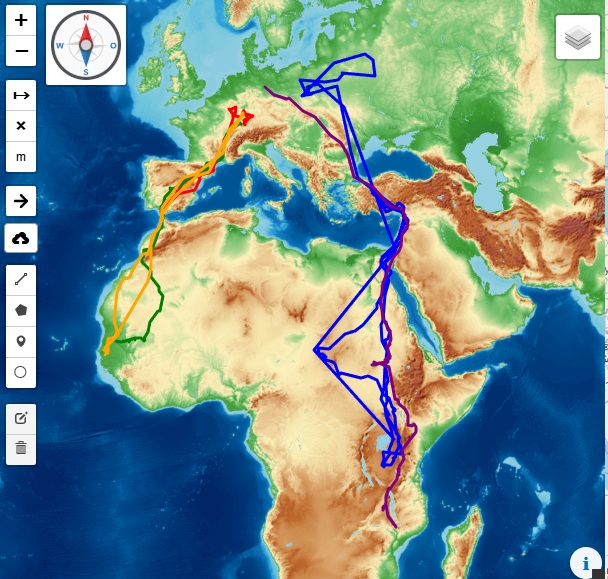
Movebank.org + ViviAn Maps (https://vivian-training.de): Interaktive Arbeitsoberfläche für Arbeit mit GPS Daten und Möglichkeit der Lernmaterialerstellung.
Die GPS Daten werden via API von der Movebank geladen und auf einer interaktiven Weboberfläche verfügbar gemacht. Gespeicherte Karten können als Lerninhalt direkt in interaktiven Lerninhalten verfügbar gemacht werden.
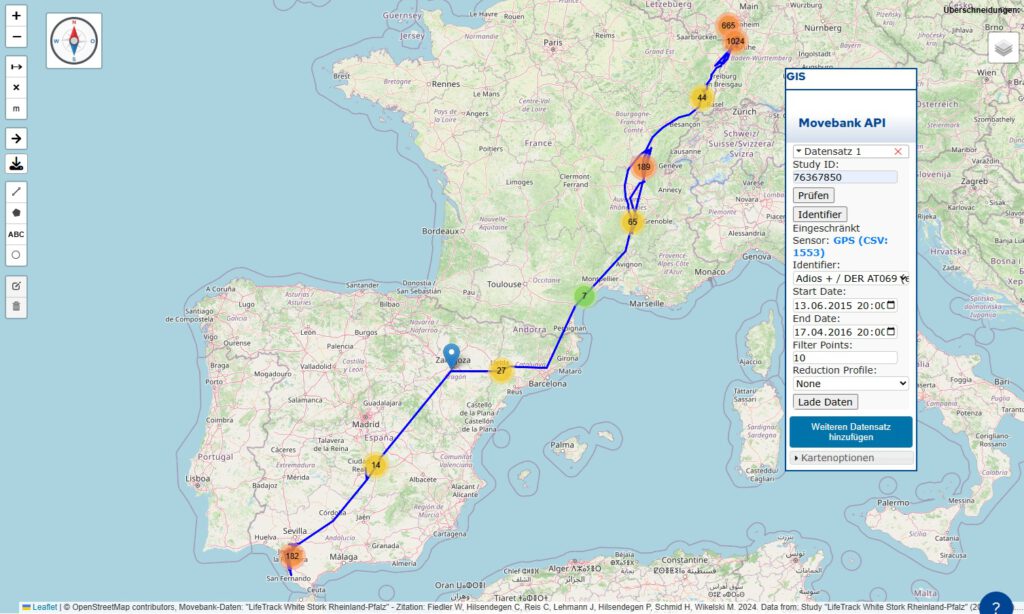
Rotfuchs (Vulpes vulpes):
Project Citation:
Red Fox (Vulpes vulpes) in UK wet grasslands
Porteus TA, Short MJ, Hoodless AN, Reynolds JC. 2024. Data from: Study „Red Fox (Vulpes vulpes) in UK wet grasslands“. Movebank Data Repository. https://doi.org/10.5441/001/1.304
These data are described in
Porteus TA, Short MJ, Hoodless AN, Reynolds JC. 2024. Movement ecology and minimum density estimates of red foxes in wet grassland habitats used by breeding wading birds. Eur J Wildlife Res. 70:8. https://doi.org/10.1007/s10344-023-01759-y
Study Summary:
The red fox (Vulpes vulpes) is a widely distributed generalist meso-predator implicated in declines of wading bird populations. In the wet grassland habitats where waders breed, wildlife managers work to mitigate fox predation risk to waders during the nesting period through lethal and non-lethal control methods. However, limited knowledge on fox movement ecology in these habitats makes it difficult to design effective management strategies. We used GPS telemetry to understand fox home range size, daily activity and movement patterns, and how these metrics may vary among wet grassland sites with different management. We caught and GPS-tagged 35 foxes in the March–June wader nesting period on two wet grassland sites in central southern England; Britford during 2016/17 and Somerley during 2018/19. We estimated home range areas from location data using local convex hulls, and from these estimates we derived the minimum fox density at each site and year. Daily activity patterns and movement behaviour of each fox were obtained using both telemetry and trail camera data. Mean fox home range area at Britford (0.21 km2, SE = 0.025) was significantly smaller than at Somerley (0.68 km2, SE = 0.067), and estimated minimum densities were around four times higher (Britford = 10.6 foxes/km2, Somerley = 2.4 foxes/km2). Foxes were more active and moved faster during twilight and night hours, but both telemetry and camera data indicate they were also active for one-third of daylight hours. Distances moved per day were variable between foxes but generally smaller at Britford. We also found evidence for dispersal during spring, with movements of up to 19 km per day. Home ranges at both wet grassland sites were smaller than comparable sites elsewhere. These indicated foxes were living at exceptionally high densities at Britford, where there is no fox control, increased food availability and where waders no longer breed. Spatio-temporal movement patterns were closely related to home range metrics, with higher levels of fox activity at Somerley, where home ranges were larger. The movements of itinerant and dispersing foxes during the nesting period suggests that lethal control would need to be very intensive to be effective. The likely anthropogenic food subsidy of fox density at Britford suggests that controlling access to similar food resources would help reduce predation pressure on breeding waders.
Study ID: 3179890710
Ausgewählte Screenshots ViviAn Maps:
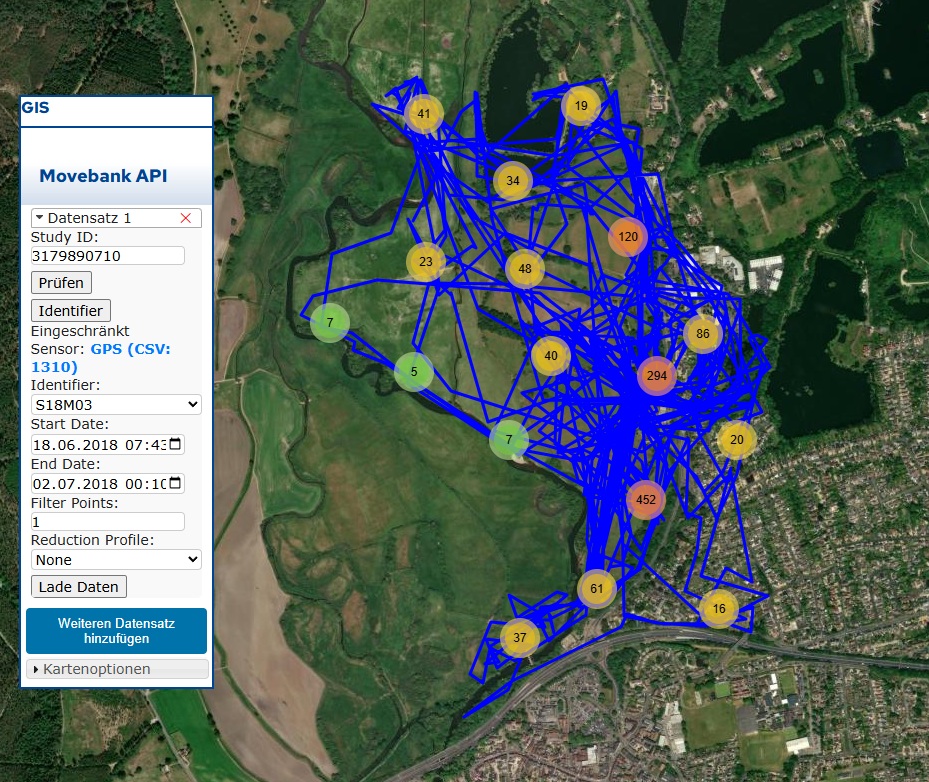
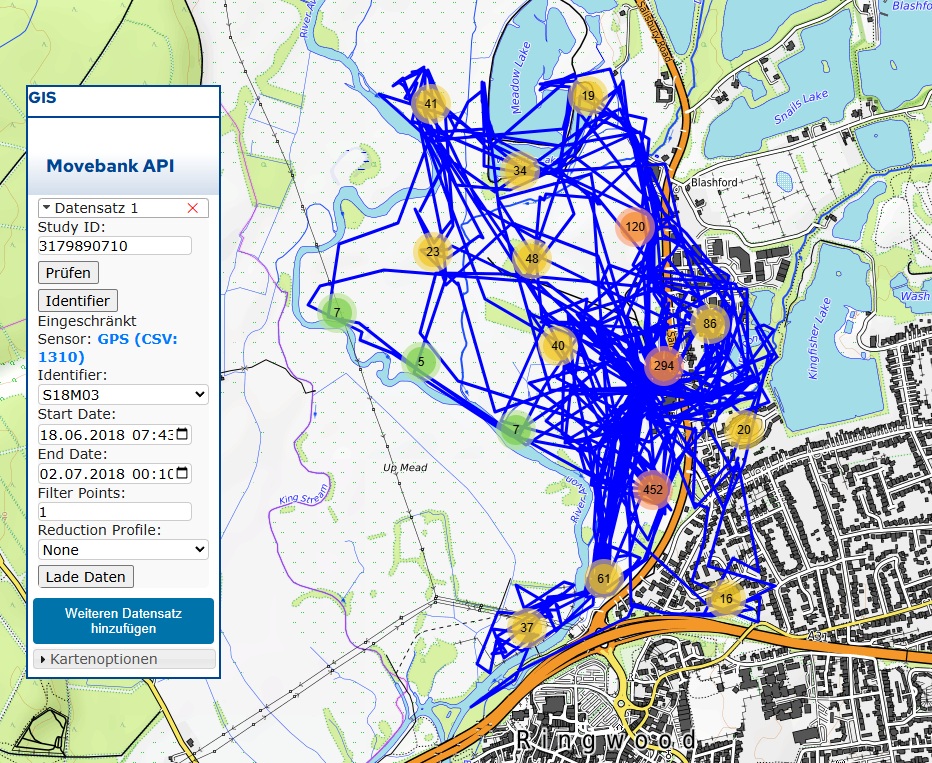
Rotfuchs S18M03, Ringwood UK
Wolf (Carnis Lupus):
Project Citation:
Bohm, H., A. Droghini, E. W. Neilson, and S. Boutin. 2018. Northern Alberta Grey Wolf, Study ID 492444603. Available on Movebank (movebank.org). Accessed on [12.05.2026].
Study Summary:
Movement data from grey wolves (Canis lupus) in northeastern Alberta’s Athabasca Oil Sands Region. Data have been used to investigate habitat use and selection (Boutin et al. 2015), predator-prey dynamics (Neilson and Boutin 2017), effects of human activity (Boutin et al. 2015; Neilson and Boutin 2017), and responses to snow conditions (Droghini and Boutin 2018). This study is participating in the Arctic Animal Movement Archive (AAMA).
Study ID: 492444603
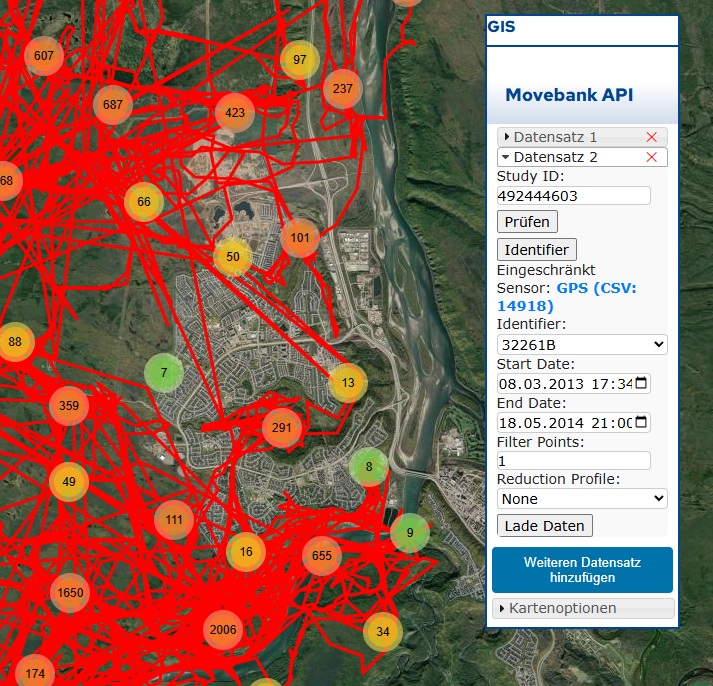
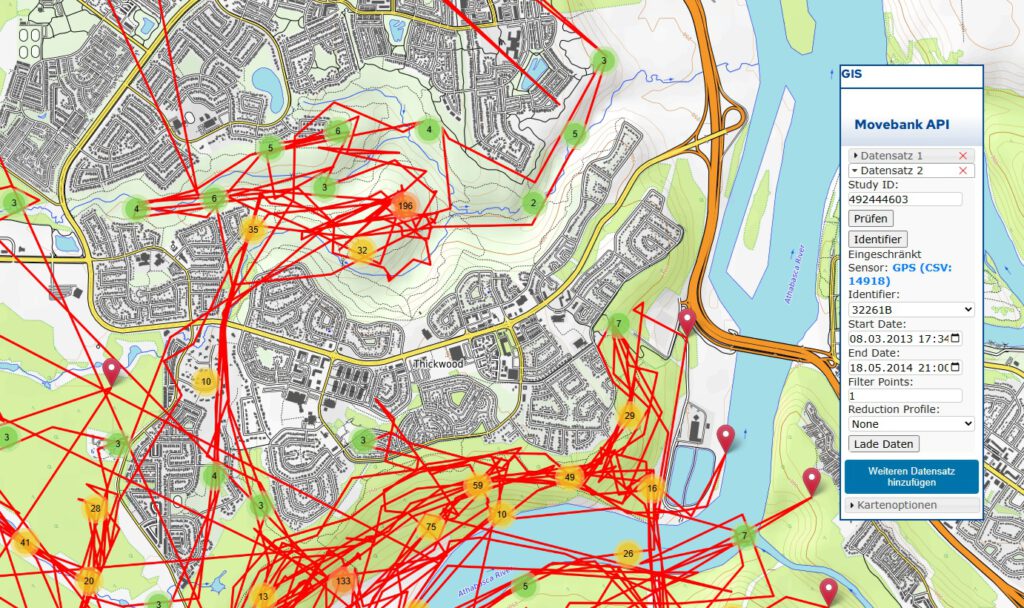
Ausgewählte Screenshots ViviAn Maps (Openstreetmap + ESRI Satellite Layer):
Wolf Carnis Lupus 32261B (Alberta, Thickwood)
Weißstorch (Ciconia ciconia):
Project Citation:
These data are described in
Bontekoe ID, Hilgartner R, Fiedler W, Flack A. 2023. The price of being late: short- and long-term consequences of a delayed migration timing. Proc Royal Soc B. 290:20031268. 10.1098/rspb.2023.1268
Brønnvik H, Nourani E, Fiedler W, Flack A. 2024. Experience reduces reliance on availability of conspecifics for route selection by a collectively migrating soaring bird. Curr Biol. 34(9):2030-2037.e3. 10.1016/j.cub.2024.03.052
Study Summary:
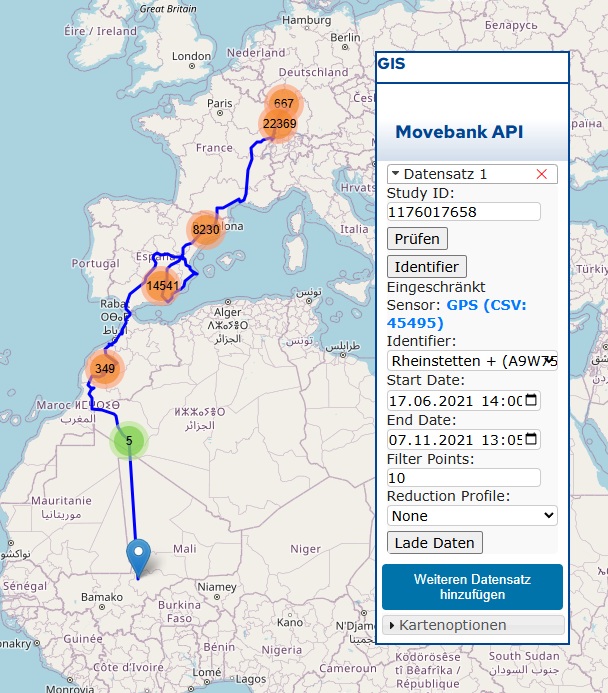
Determining migration routes of White Storks in SWGermany. Lifetime tracking of storks. Ontogeny of flight and migration, Effects of migration strategies on survival and fitness.
Study ID: 1176017658
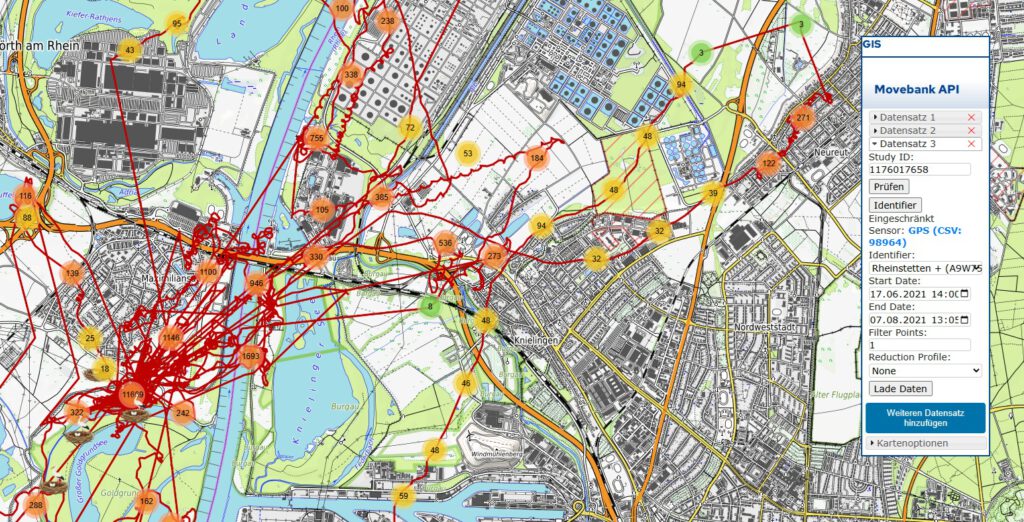
Ausgewählte Screenshots ViviAn Maps (Openstreetmap + ESRI Satellite Layer):
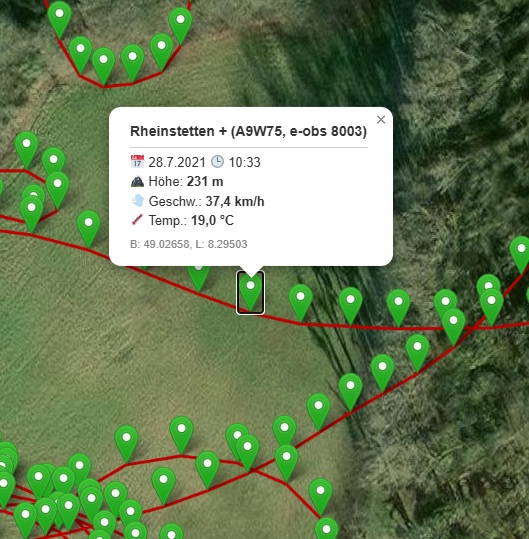
Storch Rheinstetten + (A9W75); Westzieher (Karlsruhe)
Zusätzliche Analysedaten bei den Störchen vorhanden:
Störche auf Mülldeponien bei Madrid:
Project Citation:
Fiedler W, Hilsendegen C, Reis C, Lehmann J, Hilsendegen P, Schmid H, Wikelski M. 2024. Data from: Study „LifeTrack White Stork Rheinland-Pfalz“ (2015-2023). Movebank Data Repository. 10.5441/001/1.4192t2j4_2
Aikens EO, Nourani E, Fiedler W, Wikelski M, Flack A. 2024. Learning shapes the development of migratory behavior. Proc Natl Acad Sci USA. 121(12):e2306389121. 10.1073/pnas.2306389121
Brønnvik H, Nourani E, Fiedler W, Flack A. 2024. Experience reduces reliance on availability of conspecifics for route selection by a collectively migrating soaring bird. Curr Biol. 34(9):2030-2037.e3. 10.1016/j.cub.2024.03.052
Kays R, Davidson SC, Berger M, Bohrer G, Fiedler W, Flack A, Hirt J, Hahn C, Gauggel D, Russell B, et al. 2022. The Movebank system for studying global animal movement and demography. Methods Ecol Evol. 13(2):419-431. 10.1111/2041-210X.13767
Cheng Y, Fiedler W, Wikelski M, Flack A. 2019. „Closer-to-home“ strategy benefits juvenile survival in a long-distance migratory bird. Ecology and Evolution. 9(16): 8945–8952. 10.1002/ece3.5395
Study Summary:
Lifetime tracking of storks tagged in the Rheinland-Pfalz region of Germany.
Study ID: 76367850
3 Störche in der Nähe von Madrid:
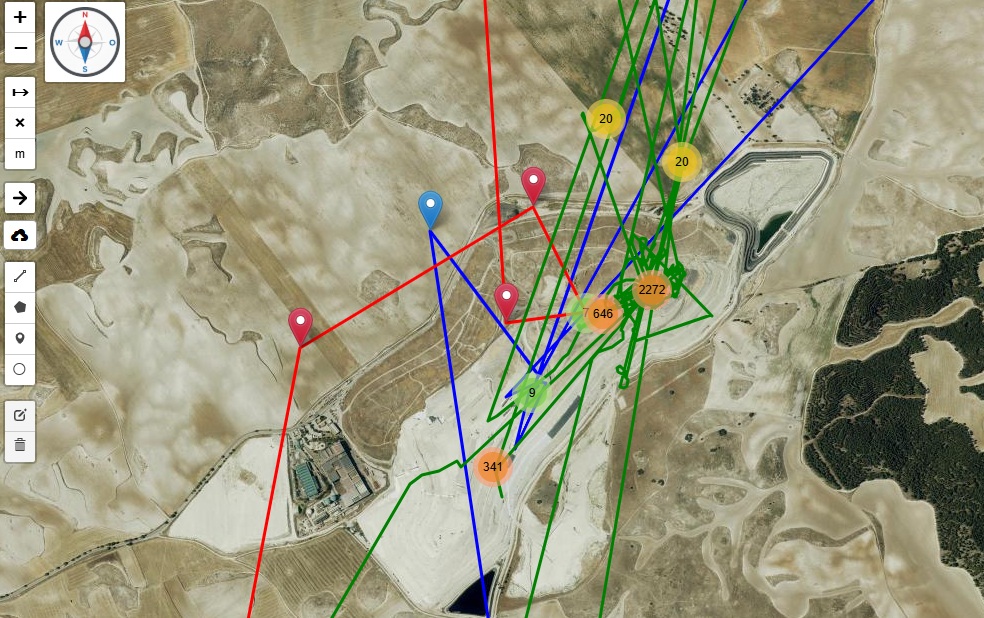
Ost- & Westzieher: